Average Typing Speed by Age: WPM Chart for Kids to Adults
Updated 11/11/2026
Most adults type around 40 words per minute, kids start far lower, and trained touch typists reach 60 to 80 or more. Here is a realistic WPM chart by age, with what counts as good.
The average typing speed for adults is about 40 words per minute (WPM), and a good speed for office work starts around 50 to 60 WPM. Children type much slower, roughly 10 to 25 WPM in primary school, and teenagers who practise can pass 40 WPM. The numbers below are rough benchmarks, not strict rules: speed depends far more on how you type than on how old you are.

Photo: Vitaly Gariev, Pexels
Average typing speed by age: the chart
The ranges below are commonly cited benchmarks, gathered from typing courses and education sources, and rounded. They are not our own test data, and every person is different. Use them to see roughly where you stand, not to judge yourself.
| Age group | Typical speed | Considered good |
|---|---|---|
| 6 to 8 years | 3 to 10 WPM | 10 WPM or more |
| 9 to 10 years | 8 to 20 WPM | 20 to 25 WPM |
| 11 to 12 years | 15 to 25 WPM | 30 WPM |
| 13 to 14 years | 20 to 35 WPM | 40 to 50 WPM |
| 15 to 17 years | 25 to 40 WPM | 45 to 60 WPM |
| Young adults (18 to 29) | 35 to 50 WPM | 55 to 70 WPM |
| Adults (30 to 59) | 30 to 45 WPM | 50 to 65 WPM |
| Seniors (60 and over) | 20 to 35 WPM | 35 to 50 WPM |
Two points matter when you read this table. First, the "typical" column includes people who type with two or three fingers and look at the keys. Second, the "good" column is what most people can reach with regular practice of touch typing, which means typing with all ten fingers without looking at the keyboard.
What WPM actually measures
WPM counts words per minute, where a "word" is a standard unit of five characters, including spaces. This standard makes results comparable between texts. A speed of 40 WPM means 200 characters a minute, or about 3.3 characters per second.
Most tests show two numbers:
- Gross WPM counts everything you typed.
- Net WPM subtracts uncorrected mistakes. This is the more honest figure, and the one employers care about.
Accuracy matters as much as speed. Someone who types 60 WPM with 8 percent errors will lose time correcting mistakes and often ends up slower than someone who types 45 WPM with 98 percent accuracy.
Typing speed by age, one group at a time
Young children (6 to 10)
Children this age are still learning to read and spell, and their hands are small. Speeds of 5 to 15 WPM are normal. At this stage the goal is not speed but good habits: correct posture, the home row, and typing without looking down. Short sessions of ten minutes work better than long ones. The home row is the right starting point.
Preteens (11 to 12)
Between 15 and 25 WPM is typical, and a child who has practised properly can reach 30 WPM. This is the age when school starts to need typed homework, so it is a good time to learn touch typing before bad habits settle in.
Teens (13 to 17)
Teenagers are the fastest-improving group. Many teens who have used phones and computers all their lives type 30 to 40 WPM, but their habits are often poor: two or three fingers, constant looking. With a few weeks of structured practice many teens reach 50 to 60 WPM. The overview Average WPM for Teens goes deeper.
Young adults (18 to 29)
This group types fastest on average, usually 35 to 50 WPM without training and 55 to 70 WPM with it. Students and early-career workers benefit most from touch typing, because they write more text than any other group: essays, notes, emails.
Adults (30 to 59)
Typical adult speed sits around 40 WPM. Many adults learned to type informally and never improved after reaching a comfortable level. The good news is that adults learn touch typing well; the process takes about the same number of weeks as for teenagers.
Seniors (60 and over)
Speeds of 20 to 35 WPM are normal, and speed matters less than comfort. Many seniors type well and enjoy it. Larger keys, good lighting and a comfortable chair matter more than WPM.
What counts as a good typing speed
A good speed depends on what you need it for:
| Purpose | Useful speed |
|---|---|
| School work and everyday use | 30 to 40 WPM |
| Office and admin jobs | 50 to 60 WPM |
| Data entry, transcription, customer chat | 60 to 80 WPM |
| Professional typists and court reporters | 80 WPM and above |
A speed of 40 WPM is enough for a student or occasional user (see Is 40 WPM Good for a 13 Year Old?). 60 WPM is comfortable for most office roles, and anything above 80 WPM is rare without years of practice.
Why age matters less than technique
Age explains only part of the differences in typing speed. The biggest factor is how you type:
- Hunt and peck (looking at the keys, using one or two fingers): usually 20 to 30 WPM, and it rarely gets better with age or experience.
- Mixed technique (some fingers, some looking): around 35 to 45 WPM.
- Touch typing (all ten fingers, eyes on the screen): 50 to 80 WPM or more, depending on practice.
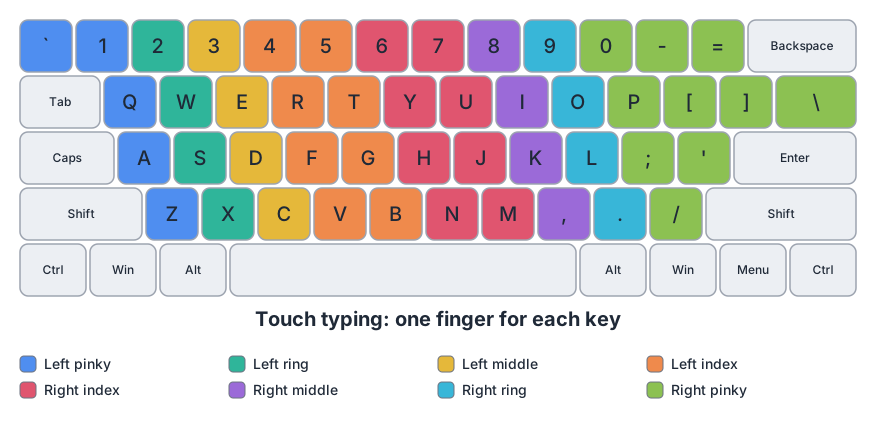
In touch typing every finger has its own keys and returns to the home row after each stroke. This is why a 14-year-old who touch types can outpace a 40-year-old who does not.
How to improve your typing speed at any age
Follow these steps, whatever your age:
- Learn the home row. Left fingers on A S D F, right fingers on J K L ;. Everything else is measured from there.
- Stop looking at the keyboard. Cover your hands with a cloth if needed. Mistakes will go up for a week or two, then drop.
- Practise accuracy first. Slow, clean typing builds the muscle memory that speed depends on.
- Practise a little every day. Ten to fifteen minutes beats an hour once a week.
- Measure monthly. Take a one-minute test once a month and note your net WPM. Do not test daily, because normal ups and downs will discourage you.
- Fix your setup. Keep your back straight, wrists level, and the screen at eye level.
Most people go from 30 to 40 WPM to 50 or more WPM within four to eight weeks of daily practice, and a goal like 60 WPM is realistic for a teen (see Is 60 WPM Good for a 14 Year Old?). If you want a guided path, start with the Touchtypely course or measure your starting point with the typing test.
Typing speed on phones
Phone typing is a different skill. Most people type 30 to 40 WPM on a phone screen with their thumbs, and speed there has little connection with keyboard speed. If you are a phone-first user, your keyboard speed is probably lower than you think. A short course can improve it quickly because you start from low.
Common mistakes when comparing your speed
- Comparing with a different test. Tests use different texts. A test with punctuation and capital letters gives a lower score than one with simple words.
- Looking only at gross WPM. A high gross speed with many errors is not a high speed.
- Testing when tired. Your results will vary by 10 to 20 percent over the day.
- Aiming for a record, not accuracy. Faster is only useful when it stays accurate.
Frequently asked questions
What is the average typing speed for adults?
About 40 WPM. Many office workers type between 40 and 60 WPM, and professional typists reach 70 to 80 WPM or more.
Is 40 WPM good?
Yes, for school and everyday use. For office work, 50 to 60 WPM is a more comfortable target.
What is the average typing speed for a 12 year old?
Roughly 15 to 25 WPM. A child who learns touch typing can reach 30 WPM or more.
Is typing speed affected by age?
A little. Young adults are fastest on average and speed drops slowly after middle age. But technique has a much bigger effect than age.
How long does it take to double your typing speed?
With daily practice of 10 to 15 minutes, many people improve by 10 to 20 WPM in one to two months. Doubling takes longer if you start from a good level.
What is a good WPM for a job?
Most office and admin jobs ask for 40 to 60 WPM. Data entry and transcription roles often require 60 to 80 WPM.